
From heritage workwear to modern fashion collections, the barn jacket represents something bigger than a single garment. It represents the growing opportunity in functional, durable and commercially relevant outerwear.
For brands looking to expand their product offering, outerwear can be one of the most valuable categories to develop — but also one of the most technically demanding.
A jacket is not simply a larger version of a shirt or sweatshirt.
Fabric weight changes. Construction changes. Hardware becomes more important. Layering affects fit. Seam strength matters. Finishing becomes more complicated. Weather resistance can become part of the product specification. And every additional pocket, lining, reinforcement or trim introduces another production consideration.
This is where the role of an experienced sourcing and manufacturing partner becomes important.
At Sahaz Unified Source, we see outerwear not simply as a manufacturing category, but as an opportunity to help brands develop better products, build stronger collections and create more value throughout the product-development process.
The Barn Jacket: A Heritage Silhouette Built Around Function
The barn jacket has its roots in practical outdoor and agricultural clothing. Its traditional appeal comes from a simple principle: the garment was designed to do a job.
Durable fabrics, generous pockets, practical closures, protective collars and comfortable silhouettes were developed around the realities of outdoor work.
That functional DNA is still visible in the modern barn jacket.
The classic silhouette is generally associated with durable cotton fabrics, a relatively relaxed or boxier shape, substantial pockets and details such as corduroy collars and weather-resistant finishes. The adjacent field-jacket category shares many of these characteristics, although field jackets can introduce more military and utility-oriented details.
Waxed cotton became particularly important to this heritage. The treatment provides water resistance and has historically been associated with outdoor and country garments, while also developing a distinctive patina through wear.
But the modern consumer is not necessarily buying a barn jacket because they work on a farm.
They are buying the idea behind it.
Durability.
Authenticity.
Utility.
Heritage.
Versatility.
And increasingly, the ability to wear something that looks purposeful without appearing overly technical.
That is why the barn jacket has successfully moved from the field into contemporary fashion.
From Workwear to Lifestyle Product
The most interesting development in heritage outerwear is that functionality and fashion are no longer mutually exclusive.
A modern barn or field jacket can be worn with denim and boots, but it can just as easily become part of a contemporary urban wardrobe.
This gives brands an opportunity.
Instead of treating the barn jacket as a single product, it can become the foundation of an entire outerwear program.
A brand could develop:
- Waxed cotton barn jackets
- Unwaxed canvas versions
- Lightweight transitional jackets
- Quilted winter versions
- Corduroy-collar field jackets
- Denim interpretations
- Cotton twill utility jackets
- Insulated versions
- Women’s and men’s coordinated silhouettes
- Premium leather-trimmed versions
- Workwear-inspired uniform jackets
The silhouette remains recognizable while the fabric, construction, color, hardware and finishing allow the product to move into completely different price points and consumer segments.
This is where manufacturing expertise becomes commercially important.
Reading the Jacket: A Technical Breakdown
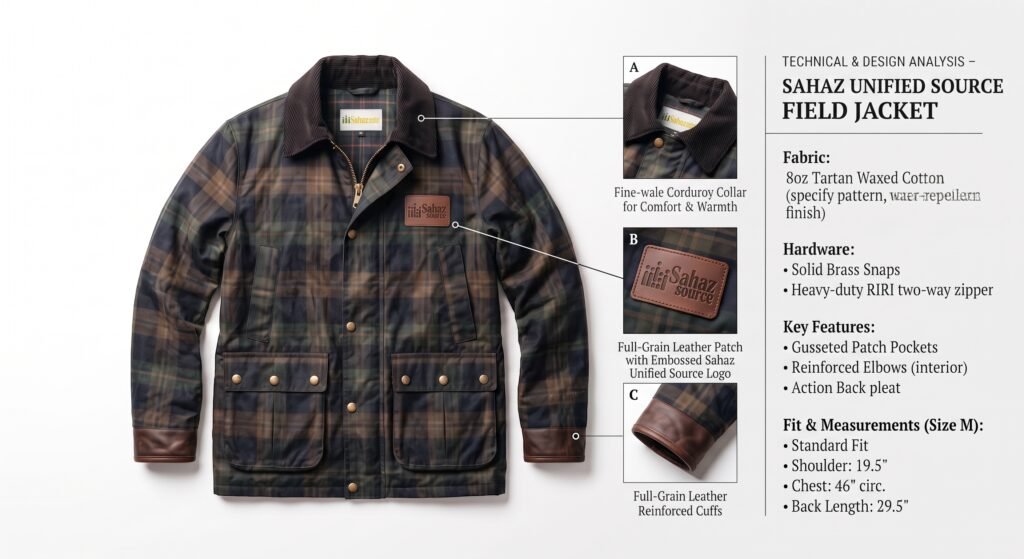
Our featured Sahaz Unified Source field jacket provides a useful example of how a heritage concept can be translated into a contemporary product.
The product board identifies an 8 oz tartan waxed cotton shell, a fine-wale corduroy collar, solid brass snaps, a heavy-duty RIRI two-way zipper, gusseted patch pockets, reinforced elbows, an action-back pleat, and full-grain leather detailing. It also specifies a standard fit with a 19.5-inch shoulder, 46-inch chest circumference and 29.5-inch back length in size M.
Each of these decisions contributes something different to the product.
1. The Fabric
The choice of 8 oz tartan waxed cotton immediately establishes the garment’s identity.
The tartan communicates heritage. The cotton provides a natural, tactile hand. The waxed finish introduces weather resistance and changes the way the fabric behaves visually and physically.
That combination makes the fabric part of the design language rather than simply a material choice.
For a buyer, however, fabric selection also creates questions:
- What is the exact composition?
- What is the finished weight?
- How consistent is the wax application?
- What level of water resistance is required?
- How does the fabric behave during cutting and sewing?
- Does the finish transfer or rub?
- How does it perform after repeated wear?
- How should it be cared for?
- Is the fabric available consistently at the required volume?
Waxed fabrics require particular attention because the coating affects weight, stiffness, drape and sewing behavior. Some manufacturers specifically adapt needle, thread, cutting and handling practices for coated fabrics rather than treating them like ordinary apparel materials.
This is exactly where a sourcing partner can add value.
The buyer should not have to discover these problems after production begins.
2. The Corduroy Collar
The fine-wale corduroy collar is more than a decorative heritage reference.
It provides contrast against the tartan shell, introduces a softer material around the neck and reinforces the traditional visual language associated with country and field outerwear.
For Sahaz, this becomes an opportunity to offer buyers choices.
A buyer could select:
Classic: Brown corduroy collar with olive waxed cotton.
Contemporary: Tonal corduroy with a dark tartan.
Premium: Suede or leather collar.
Fashion: Contrast corduroy in a seasonal color.
The same basic jacket block can therefore become several different commercial products.
That is an important concept:
Good product development does not always mean creating a completely new garment. Sometimes it means creating multiple commercial opportunities from one strong foundation.
3. Hardware as a Design and Performance Component
The jacket uses solid brass snaps alongside a heavy-duty RIRI two-way zipper.
This is a significant design decision.
Hardware is highly visible on outerwear. Cheap or poorly specified hardware can immediately make an otherwise premium jacket feel inexpensive.
Conversely, properly selected hardware can reinforce the entire product identity.
For buyers, Sahaz can help evaluate:
- Zipper specification
- Snap quality
- Puller design
- Finish and plating
- Corrosion resistance
- Color consistency
- Hardware strength
- Hardware availability
- Cost implications
This is where sourcing becomes more than finding the lowest possible price.
It becomes value engineering.
The objective is to determine where the buyer should invest and where the product can be simplified without compromising its identity.
4. Pocket Engineering
The jacket features large gusseted patch pockets.
This is one of the defining characteristics of utility-inspired outerwear.
But pockets are also surprisingly complex from a manufacturing perspective.
The size, placement, gusset depth, flap construction, reinforcement and opening all affect both appearance and usability.
For a fashion buyer, the question is not simply:
“Can the factory sew this pocket?”
The better question is:
“Does this pocket perform the function the design promises?”
That difference is important.
Sahaz can work with buyers during development to assess pocket dimensions, placement, reinforcement and construction before bulk production.
5. Reinforcement and Durability
The product board also highlights reinforced elbows and leather-reinforced cuffs.
These details communicate durability visually, but they can also serve a genuine functional purpose.
For an outerwear buyer, reinforcement creates another layer of product-development decisions:
Where does the garment experience stress?
How should that stress be distributed?
Which areas require additional fabric or reinforcement?
Can reinforcement be incorporated without making the garment unnecessarily heavy?
This is where outerwear manufacturing differs from simply producing a standard woven garment.
The construction has to account for the way the wearer moves, layers clothing and interacts with the garment.
6. The Action-Back Pleat
The action-back pleat is perhaps one of the most interesting details in this design.
It connects the garment to the original functional philosophy of field and workwear.
A jacket intended for outdoor movement cannot simply be designed around a static standing pose.
The wearer reaches, bends, drives, carries, works and moves.
An action-back construction can provide additional movement while preserving the overall silhouette.
For a buyer, this is an example of how heritage details can have genuine product value rather than being purely decorative.
Why Outerwear Manufacturing Requires a Different Mindset
Outerwear brings together multiple disciplines:
Textiles + pattern engineering + construction + hardware + finishing + testing + quality control + costing.
That makes the category considerably more complicated than many basic apparel programs.
A buyer may begin with a simple reference image.
But turning that image into a repeatable production garment requires answering dozens of questions.
What fabric?
What weight?
What finish?
What lining?
What seam construction?
What zipper?
What snap?
What reinforcement?
What pocket construction?
What stitch density?
What thread?
What tolerances?
What testing?
What packaging?
What care instructions?
What target FOB?
What quantity?
What size range?
And ultimately:
Can the product be produced consistently at the buyer’s required commercial price?
That is the real challenge.
Where Sahaz Unified Source Can Add Value
This is where we believe the opportunity for Sahaz goes beyond simply being a manufacturing intermediary.
The stronger proposition is to become an outerwear development and sourcing partner.
Instead of waiting for a buyer to provide a complete tech pack, Sahaz can help take a product from concept to production.
1. Concept Development
A buyer may come with:
- A reference jacket
- A sketch
- A mood board
- A competitor sample
- A photograph
- A fabric idea
- Or simply a description of the product they want
Sahaz can help translate that idea into a manufacturable product.
2. Fabric Sourcing
Rather than presenting buyers with one fabric option, Sahaz can develop a material matrix around the target product.
For example:
| Product Direction | Possible Fabric |
|---|---|
| Traditional barn jacket | Waxed cotton / duck canvas |
| Lightweight version | Cotton twill |
| Premium heritage | Waxed cotton + leather |
| Winter version | Quilted cotton / insulated construction |
| Contemporary version | Washed cotton canvas |
| Denim interpretation | Heavyweight denim |
| Utility version | Cotton-nylon blend |
| Sustainable direction | Recycled or preferred-fiber alternatives |
The buyer can then make a commercial decision based on look + performance + cost, rather than choosing blindly.
3. Build a Modular Outerwear Platform
This may be one of the biggest opportunities for Sahaz.
Instead of selling a single jacket, develop a core outerwear block that can be adapted.
One base pattern can potentially become:
Barn Jacket → Field Jacket → Chore Jacket → Utility Jacket → Lightweight Overshirt → Quilted Jacket
The silhouette, pocket architecture, collar construction and trims can change while the development knowledge carries forward.
That reduces development duplication and can make it easier for a buyer to build a cohesive collection.
4. Help Buyers Build Complete Outerwear Collections
Sahaz can approach a buyer with a bigger proposition:
Don’t just develop one jacket. Let’s build your outerwear category.
For example, a seasonal collection could include:
Hero Product
Premium waxed barn jacket
Commercial Product
Unwaxed cotton field jacket
Entry Product
Lightweight cotton utility jacket
Winter Product
Quilted field jacket
Fashion Product
Contemporary cropped or oversized interpretation
This gives the buyer different price points while maintaining a consistent brand identity.
And from Sahaz’s perspective, it creates a deeper relationship with the customer.
5. From Manufacturer to Product Development Partner
This is perhaps the biggest strategic lesson from the jacket.
A buyer does not ultimately need another supplier who says:
“Send us the tech pack and we will make it.”
They need a partner who can say:
“Tell us what you want the product to achieve. We will help you figure out how to make it.”
That means Sahaz can potentially offer a broader service structure:
Product Development
Concept → fabric → trims → construction → sample
Sourcing
Fabric → hardware → lining → labels → packaging
Technical Development
Pattern → measurements → construction → fit → revisions
Production
Cutting → sewing → finishing → inspection
Quality
In-line inspection → final inspection → testing coordination
Commercial Support
Cost engineering → alternative materials → price-point development → collection planning
This creates considerably more value than simply arranging production.
The Buyer Problem Sahaz Can Solve
Imagine a growing fashion brand that wants to launch its first outerwear collection.
They may understand their customer extremely well.
They may have strong design direction.
But they may not know:
- Which canvas weight to use
- How waxed cotton behaves during production
- Which zipper specification makes sense
- How much reinforcement is necessary
- How to construct a functional gusset
- How to grade a jacket across sizes
- How to control outerwear tolerances
- How to achieve the desired hand feel
- How to balance premium trims against target cost
That is where Sahaz can become valuable.
The brand brings the vision.
Sahaz brings the development and manufacturing pathway.
Turning One Jacket Into a Broader Business Opportunity
The field jacket shown here should therefore be viewed as more than a sample.
It can become a demonstration of capability.
A buyer looking at this product should immediately be able to imagine:
“If they can develop this, perhaps they can develop our entire outerwear collection.”
That is the commercial objective.
The jacket demonstrates understanding of:
- Fabric selection
- Waxed finishes
- Pattern engineering
- Collar construction
- Hardware
- Pockets
- Reinforcement
- Leather detailing
- Functional movement
- Fit
- Product presentation
And those capabilities can transfer into other outerwear categories.
The Future of Outerwear Is Not Simply About Making More Jackets
The opportunity is to make better products with clearer commercial purpose.
Today’s outerwear buyer is balancing design, quality, cost, functionality, sustainability, consumer expectations and speed to market.
A sourcing partner that can help manage those decisions becomes significantly more valuable than a supplier focused only on production.
For Sahaz Unified Source, this creates an opportunity to build a stronger position in the market:
Not simply as a garment manufacturer.
Not simply as a sourcing company.
But as a product development and outerwear manufacturing partner capable of helping brands turn concepts into commercially viable garments.
From the Barn to the Brand
The barn jacket started with a simple idea: build something useful enough to withstand real life.
That principle remains relevant.
Modern consumers may wear these garments in cities rather than barns, but they still respond to the same fundamental qualities — durability, authenticity, functionality and timeless design.
The challenge for modern brands is translating those qualities into products that fit their identity, price point and customer.
That is where the right manufacturing partner makes the difference.
At Sahaz Unified Source, our goal is to help buyers move beyond simply ordering garments.
We want to help them develop products, build collections, solve technical challenges and create outerwear programs that add real value to their brands.
Because the strongest outerwear isn’t defined by how complicated it looks.
It is defined by how well every detail works together.
And that is where good manufacturing begins.
Looking to develop your next outerwear collection?
Let’s build it together.